FREE SHIPPING on orders of 4,000 TL or more


Blog
How Do Scents Affect Our Psychology? On Aromatherapy and Aromapsychology


How Do Scents Affect Our Psychology? On Aromatherapy and Aromapsychology
A scent can sometimes transform the atmosphere of a room. Sometimes it transports a person back to years ago. Sometimes, even before you realize what you’re feeling, your body has already responded.
A perfume can remind you of someone you wanted to forget.
The scent of a plant can bring back a cool morning from your childhood.
A citrus scent can clear the mind; a soft aroma like lavender can invite the body to slow down.
Scent is invisible, but its effect is tangible. That’s why the question of how scents affect our psychology isn’t just about pleasant smells or personal taste. This question concerns memory, emotion, stress, focus, body awareness, and how we regulate our inner world.
Aromatherapy and aromapsychology converge precisely at this point.
Aromatherapy is based on the use of essential oils derived from plants to promote well-being. Aromapsychology, on the other hand, is a more specialized field that seeks to understand the effects of scents on a person’s mental, emotional, and behavioral states.
Aromatherapy works with the scent of the plant; aromapsychology seeks to understand what the scent changes in a person.
What Is Aromatherapy? What Is Aromapsychology?
Aromatherapy is the use of essential oils derived from plants—through scent, touch, or ritual—to support well-being. Historically, aromatic plants and oils have been used for a long time in ancient cultures such as Egypt and India; modern aromatherapy, however, gained prominence in scientific literature with René-Maurice Gattefossé.
Aromapsychology, on the other hand, focuses on a narrower and more mental realm. Its fundamental question is:
How does a scent affect a person’s mood, attention, memory, and behavior?
For this reason, aromapsychology does not merely address the question, “Which oil is good for what?” It delves deeper. It seeks to understand which emotions a scent evokes in a person, which memories it triggers, whether it calms the individual, whether it promotes mental clarity, and in which situations it can be most supportive.
Experts associate aromapsychology with the assessment of mental, psychological, and hormonal states through the use of essential oils. Many sources indicate that essential oils can be categorized into harmonizing, adaptogenic, stabilizing, relaxing, and stimulating groups based on their psychological effects.
We can translate this technical classification into more accessible language:
Some scents bring balance.
Some promote harmony.
Some relax.
Some invigorate.
Some clear the mind.
And some bring a person back to their body and to the present moment.
Scent and the Brain: Why Do Some Scents Change Us Instantly?
Scent, unlike other senses, does not operate at a distance. When a scent reaches us, we usually don’t think about it first; we feel it directly.
That’s why a scent can sometimes evoke a memory faster than a visual image. It does what a sound cannot. It can instantly bring back a period in time, a garden, a person, a home, a piece of writing, or a loss—things that cannot be described in a single sentence.
What’s important here is that scent forms a strong connection with emotion and memory. Studies conducted worldwide also indicate that the effects of scents on memory, attention, and emotional state constitute a significant area of research in aromatherapy.
That is why the relationship between scent and memory is much more than a simple longing for nostalgia. Scent is a sensory key that can alter a person’s inner state.
Sometimes a scent relaxes the body.
Sometimes it sharpens the mind.
Sometimes it instills a sense of security.
And sometimes it creates a restlessness within us that we cannot immediately understand.
The Psychological Effects of Scents: Emotion, Memory, and Behavior
First comes emotion. Some scents soothe a person, some invigorate, and some make us feel safer or more alert. For example, while soft scents like lavender are generally associated with relaxation and slowing down, sharper scents like rosemary and mint can be linked to a sense of mental clarity and alertness.
The second area is memory. A scent can bring back a memory—one that is often thought to have been forgotten—not just through its visual image, but along with the emotion associated with it. That’s why a scent doesn’t merely “remind” you of something; it transports you into the atmosphere of that memory.
The third area is behavior. The scent of an environment can influence how a person feels and behaves within it. Heavy, artificial, and suffocating scents can create tension, while natural, balanced, and personalized scents can foster a calmer, more open, or more focused state of mind.
For this reason, aromapsychology approaches scent not merely as an aesthetic element, but as a sensory domain capable of influencing human behavior.
How Can the Psychological Effects of Essential Oils Be Categorized?
From the perspective of aromapsychology, it is not enough to simply categorize essential oils as “pleasant-smelling” or “pungent.” The effect of scents on mood can be interpreted from a more functional perspective.
Balancing Scents
Balancing scents are those that help restore a person’s inner state without pushing it to extremes. They are neither overly stimulating nor completely sedating. Rather, they guide a scattered mind, fluctuating mood, and inner turmoil toward a more balanced state.
These types of scents can create a supportive ritual space, particularly for people who are exposed to too many stimuli throughout the day, whose minds are constantly distracted, and who experience rapid emotional shifts.
Harmonizing Scents
Adaptive scents can be thought of as scents that help the body and mind transition more smoothly through changing conditions. Seasonal changes, periods of intense work, travel, sleeplessness, adjusting to a new environment, or times of emotional transition make this group particularly meaningful.
Experts note that “adaptogenic” oils are associated with general well-being and autonomic nervous system balance in situations requiring stress management and adaptation.
This is a very valuable area in modern life. This is because people today are often forced to adapt to many different roles, emotions, and environments—sometimes even within the same day.
Relaxing Scents
Relaxing scents help slow down the nervous system. These scents are generally most effective in the evening, before sleep, after intense mental work, or during times of increased internal tension.
The goal here is not to sedate the person, but to create space for the body to remember its own natural ability to slow down. At this point, the scent acts as a signal: “You can stop now.”
Invigorating Scents
Invigorating scents have a brighter, more alert, and more energetic effect. Citrus notes, fresh green scents, and certain spicy and sharp aromas fall into this category.
These scents can be used especially in the morning, during low-energy moments, or when mental alertness is needed. But moderation is key here as well. Using them too sharply or intensely can become exhausting rather than supportive.
Focus-Supporting Scents
Focus-supporting scents help channel the mind toward a single task. Clearer, fresher scents such as rosemary, mint, bay leaf, and lemon are frequently mentioned in this context.
The power of these scents lies not only in their stimulating effects but also in their ability to dispel mental fog. The conscious use of scent during work, reading, writing, planning, or creative thinking can become a kind of sensory focus ritual.
How Does Aromatherapy Affect Mood?
The effect of aromatherapy on mood cannot be explained by the scent molecule alone. The effect often arises from a combination of several factors.
There is the scent itself.
There are the personal memories associated with the scent.
There is the method of application.
There is repetition.
There is intention.
There is the environment.
Simply spraying a scent in a hurry is not the same as making it part of a small ritual. Because when a ritual is repeated, the brain begins to associate that scent with a specific mood.
For example, using the same calming scent every evening before bed can, over time, send the message to the body that “it’s time for night.” Starting the day with the same refreshing scent in the morning can signal to the mind to “wake up and focus.”
That’s why aromatherapy goes beyond just plant-based ingredients; it’s a matter of routine, repetition, and sensory memory.
Why Does the Effect of a Scent Vary from Person to Person?
One of the most important aspects of aromapsychology is this: The same scent does not have the same effect on everyone.
For one person, lavender may be comforting and calming. For another, it may evoke a negative memory from the past. The scent of orange, which brings joy to one person, may be perceived as too sweet or overpowering by another. Rosemary, which clears one person’s mind, may be too sharp for another.
This is not a weakness of aromatherapy, but rather the nature of human memory and psychology. A scent may carry a universal biological effect, but personal memory adds its own meaning to that effect.
That is why a good aromatherapy approach is not based solely on the simplistic logic of “This oil is good for that.” The individual’s relationship with scent, their life rhythm, needs, sensory sensitivity, and memory are also important.
This is of great value to Terra di Simana, because every product is part of the relationship a person builds with their inner self.
Why Do We Need Scent Rituals in Modern Life?
The modern mind is constantly stimulated. Notifications, screens, city noise, enclosed spaces, intense decision-making processes, and endless distractions keep the nervous system in a constant state of activity. That’s why we need brief but effective sensory respites throughout the day.
Scent is a powerful tool here. It’s fast, portable, and—when used correctly—can open a small door that transforms a person’s inner state.
A scent can transport the mind to another state in just a few seconds.
A ritual can create a small sense of order amid the chaos of the day.
A repetition can send a reassuring signal to the body.
For this reason, aromatherapy and aromapsychology should not be viewed merely as a “natural product” trend in the midst of modern life. The real issue runs much deeper: People are relearning how to regulate their moods using their own senses.
Scent at Terra di Simana: Not a Perfume, but a Personal Ritual
At Terra di Simana, scent is not merely thought of as a perfume worn for others to notice. Scent is an invisible ritual tool that people use to organize their own inner space. That is why different forms address different needs.
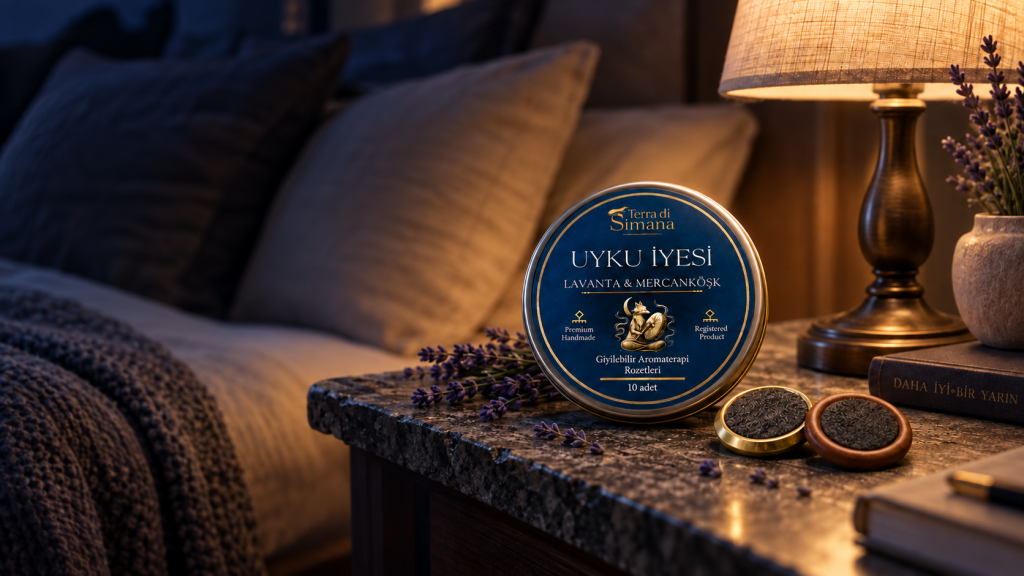
Wearable aromatherapy badges transform scent into a personal space that can be carried throughout the day. The scent doesn’t stay in a room; it moves with the person. This portability is especially important on busy days, in crowded environments, or when there’s a need for focus or balance.
Space and aura sprays are designed to quickly transform a space’s sensory atmosphere. A room’s ambiance changes not only through ventilation but also through its olfactory atmosphere. That’s why sprays are among the most practical tools of modern ritual.
Pulse point oils, on the other hand, combine scent with physical touch. Conscious application to the wrist, abdomen, soles of the feet, or other appropriate points connects the aroma not only to the sense of smell but also to body awareness.
The essence of this approach is this:
Scent works inward first, not outward.
It first organizes a person’s own space.
Then it transforms their relationship with the world.
A Small Aromapsychology Ritual with Scents
Choose a moment during the day. It doesn’t have to be very long—even a minute is enough.
First, ask yourself this question: “What do I need right now?”
To calm down?
To focus?
To energize?
To ground yourself?
To slow down?
Then choose the scent accordingly.
When you apply the scent, don’t move on to something else right away. For a few breaths, simply notice the scent. Observe where the scent, as it enters through your nose, resonates in your body. Is it in your chest? Your head? Your abdomen? Your shoulders?
Then ask the second question:
“What has this scent changed in me?”
The answer doesn’t have to be big. Sometimes your breath simply slows down. Sometimes your focus sharpens. Sometimes the tension inside you eases a bit. Sometimes it’s just the feeling of “I’m here, right now.”
Aromapsychology begins precisely with this awareness.
Conclusion: Scent Is an Invisible Language of Psychology
Scent is invisible, yet it affects us. It can transform a room, a memory, a mood, or a physical sensation. That’s why aromatherapy isn’t just about pleasant scents. Nor is aromapsychology merely an academic concept.
Together, they enable people to regulate their inner state more consciously through their senses.
Modern life often forces us to live solely in our minds. We think about everything, analyze it, plan it, and try to control it. Yet a person is not just a mind. The body, memory, emotions, and the senses are all part of this story.
Smell is one of the rare senses capable of touching all these areas at once.
That is why, when used with the right scent, at the right time, and with the right ritual, it opens a small yet powerful path for a person to turn inward.
Terra di Simana’s perspective on scent begins precisely here:
Scent is not merely an adornment.
It is a reminder.
A shift in direction.
A way of creating an inner space.
And sometimes, all a person needs is the right scent, the right moment, and a brief pause—just long enough to turn inward.