FREE SHIPPING on orders of 4,000 TL or more



Blog
What Is a Ritual? Scientific Facts, Psychology, and Modern Rituals


What is a ritual? Why are rituals so effective? This question is being increasingly explored by both psychology and modern science.
Rituals are not meaningless. The human mind structures itself through repetition, order, and meaning.
Those small repetitions you do unconsciously throughout the day—repeating the same movement in a stressful moment, counting to yourself before something happens,
getting ready in the same order every morning…
None of these are mere habits. They are the mind’s way of protecting itself from becoming scattered.
When a person loses a sense of control, their mind does not remain in a state of emptiness. On the contrary, it quickly constructs a structure—a personal, well-defined, repeatable order… And that order is often called a ritual.
Why are rituals so effective? Because they create certainty amid uncertainty. They give the mind a sequence to hold onto and the body a movement to repeat.
That is why a ritual is not merely a behavior; it is the mind’s way of reorganizing itself.
As long as a person can establish even a small amount of order in the midst of chaos, they do not fall apart.
And more often than not, the simplest and most powerful form of that order is a ritual.
What Is a Ritual? Why Do We Perform Rituals? Historical and Cultural Foundations
This is not a new discovery. From the very beginning, humanity has organized itself not through solitary thought, but through systematic movements.
Shamans walked with smoke—to purify, to protect, to clear the space.
Buddhists sat with incense—to slow the mind, to focus attention on a single point.
Hindus purified themselves with water—to cleanse the body while simultaneously experiencing an inner transformation.
Ablution in Islam, the Mass in Christianity, Shabbat in Judaism…
Different geographies, different faiths, different languages… But the same structure.
- Again
- A specific sequence
- Meaning imbued
- Sensory experiences such as scent, water, and sound
This commonality is no coincidence. Because the answer to the question “Why are rituals performed?” is independent of culture; it lies hidden in human nature.
Humans do not transform through thought alone. Thought is not lasting unless it is embodied.
This is precisely what a ritual does. It makes the abstract concrete. It transforms thought into action, and action into experience.
And in this way:
- Ritual brings the mind down into the body.
- And it reconnects the body to the mind.
That is why there is one truth that has remained unchanged for centuries: People deepen meaning by repeating it.
What Does Science Say? What Is a Ritual According to Science?
At this point, the question is clear: Is ritual just a belief, or does it actually work?
The scientific perspective on this is surprisingly clear.
Studies show that rituals reduce anxiety and increase a sense of control, especially during times of stress and uncertainty
(Norton & Gino, 2014).
In other words, a ritual is not merely a symbolic behavior; it is a measurable psychological effect.
1. Repetition → Mental Confidence and Control
The fundamental power of rituals comes from the framework they provide for the mind. When uncertainty increases, the mind becomes scattered. But a repetitive action creates an anchor amid this scattered state.
That is why people:
- Before an exam
- Before an important meeting
- During moments of intense stress repeat the same behaviors.
Because the mind seeks order. And rituals provide that order.
Why do rituals calm people down? Because they send this message to the mind: “You’re in control.”
2. Smell → Limbic System (The Center of Emotions)
Smell is one of the brain’s most primitive and fastest-acting pathways. Unlike other senses, it connects directly to:
- To memory
- Emotions
- The stress response.
That’s why a scent can change your emotional state in a matter of seconds.
Meta-analyses on aromatherapy show that essential oils—especially lavender—reduce anxiety levels and promote relaxation. In other words, scent is the fastest gateway to ritual.
3. Sound → Regulates the Nervous System
Rhythmic sounds, frequencies, and vibrations… These are not merely auditory experiences. They are biological stimuli that interact directly with the nervous system.
- Bell
- Mantra
- Frequency
- Sounds of nature slow down the body and calm the mind.
Research shows that sound-based practices can reduce tension and stress levels
(PMCID: PMC4036702).
4. Touch → Brings the Body into the Present
The mind wanders between the past and the future, but the body is always in the present.
Running your fingers over something… Consciously touching a spot… Performing a movement with awareness…
- Activates the body
- Brings the mind back to the present
That is why rituals are not just mental experiences—they are physical ones as well.
Now, within the framework of science, the picture is becoming clearer:
- Repetition
- Scent
- Sound
- Touch—when these come together, the result is not a simple habit, but a multi-layered mechanism for regulating the nervous system.
Why Are Rituals More Necessary in Modern Life?
Today’s problem isn’t scarcity; it’s excess. The mind grows weary because it can no longer find any space.
A constant stream of notifications, unfinished thoughts, interrupted attention…
A person starts one task, gets interrupted by another stimulus, then moves on to yet another.
As the day goes on, instead of the order that should be building up inside the mind, a fragmented flow takes shape.
This fragmentation often goes unnoticed. But its impact is profound.
- Focus weakens.
- Thoughts become muddled.
- A mild restlessness begins inside and spreads over time.
The fatigue of modern people often stems not from the body, but from constantly divided attention.
This is precisely where ritual takes on meaning. Ritual interrupts the flow. It gathers what has been scattered into a single thread. It guides the mind and invites the body to follow that direction.
The repetition of a movement, the release of a scent, a breath taken with awareness… These may seem small, but their effects are profound. Because ritual reminds the mind: “Not everything has to happen at once.”
That is why the answer to the question of why rituals are effective lies in the pace of modern life.
Rituals, in turn, simplify the mind, reduce unnecessary stimulation, slow down the nervous system, and draw a person back inward, toward their own center.
As the outside world speeds up, rituals create balance within.
The New Form of Ritual in Modern Life
In the past, rituals required a specific time, space, and preparation. People would pause for the ritual, carve out a space for themselves, and consciously enter that process.
Today, however, the pace of life has changed. For most people, it’s no longer possible to engage in lengthy rituals throughout the day. Yet the need hasn’t disappeared.
The mind still gets tired, attention still wanders, and stress levels rise. That’s why rituals haven’t disappeared entirely—they’ve simply taken on a new form.
Modern rituals:
- Can be performed in a shorter amount of time,
- Can be easily integrated into the day,
- Can be carried with you at all times,
- Are repeatable and sustainable.
Instead of setting aside a separate time for a ritual, the ritual becomes part of your daily routine.
For example:
- A short breathing exercise
- Focusing with a crystal-infused room spray
- Consciously repeating a specific movement
- Wearing wearable aromatherapy—these form the foundation of this new generation of rituals.
The advantage of this approach is:
- The ritual becomes sustainable
- It can be practiced regularly
- It directly contributes to daily stress management
As a result, rituals have not disappeared from modern life. On the contrary, by taking on a more practical and accessible form, they have become an effective tool for maintaining mental balance.
Terra di Simana: The Livable Form of Ritual
Terra di Simana is built on an approach that doesn’t complicate the ritual but integrates it into daily life.
Because rituals find their true meaning not only when confined to special occasions, but when they can be practiced throughout the day.
For this reason, the following products have been developed:
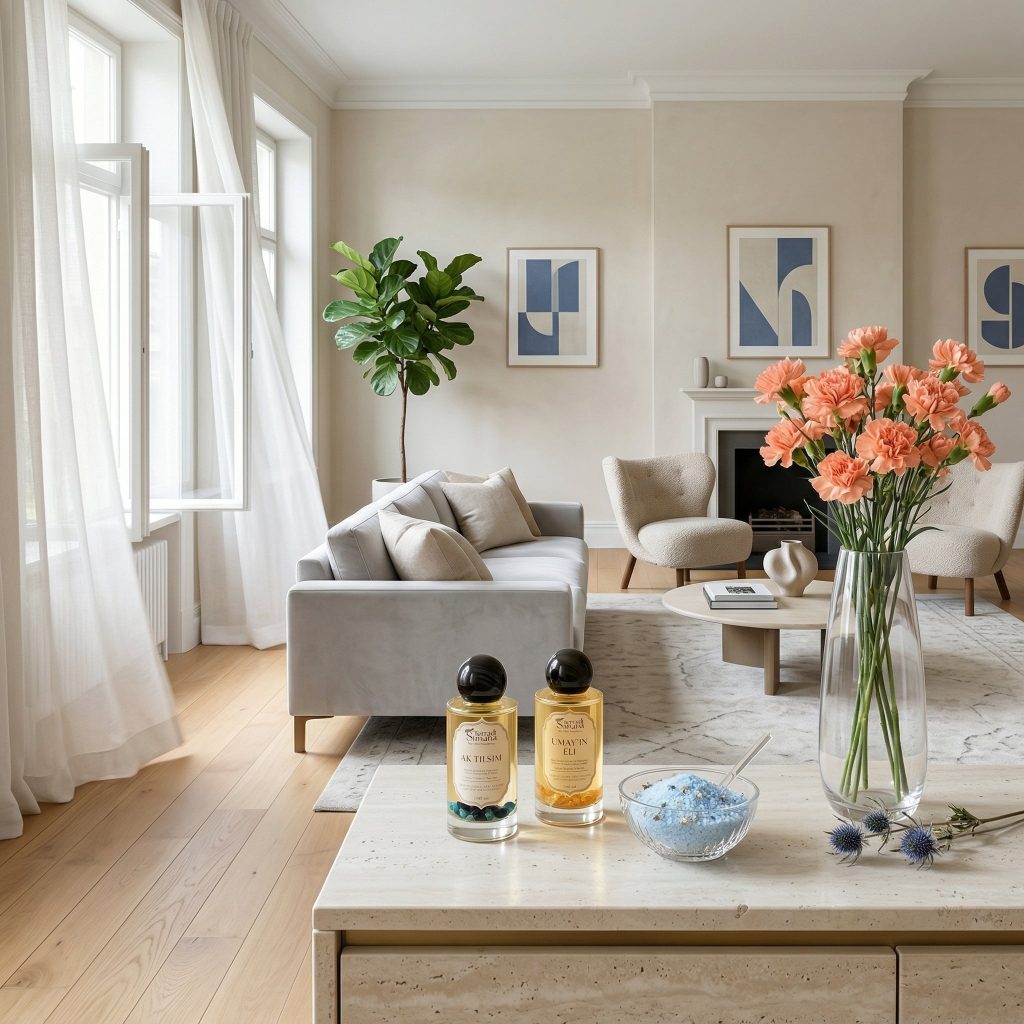
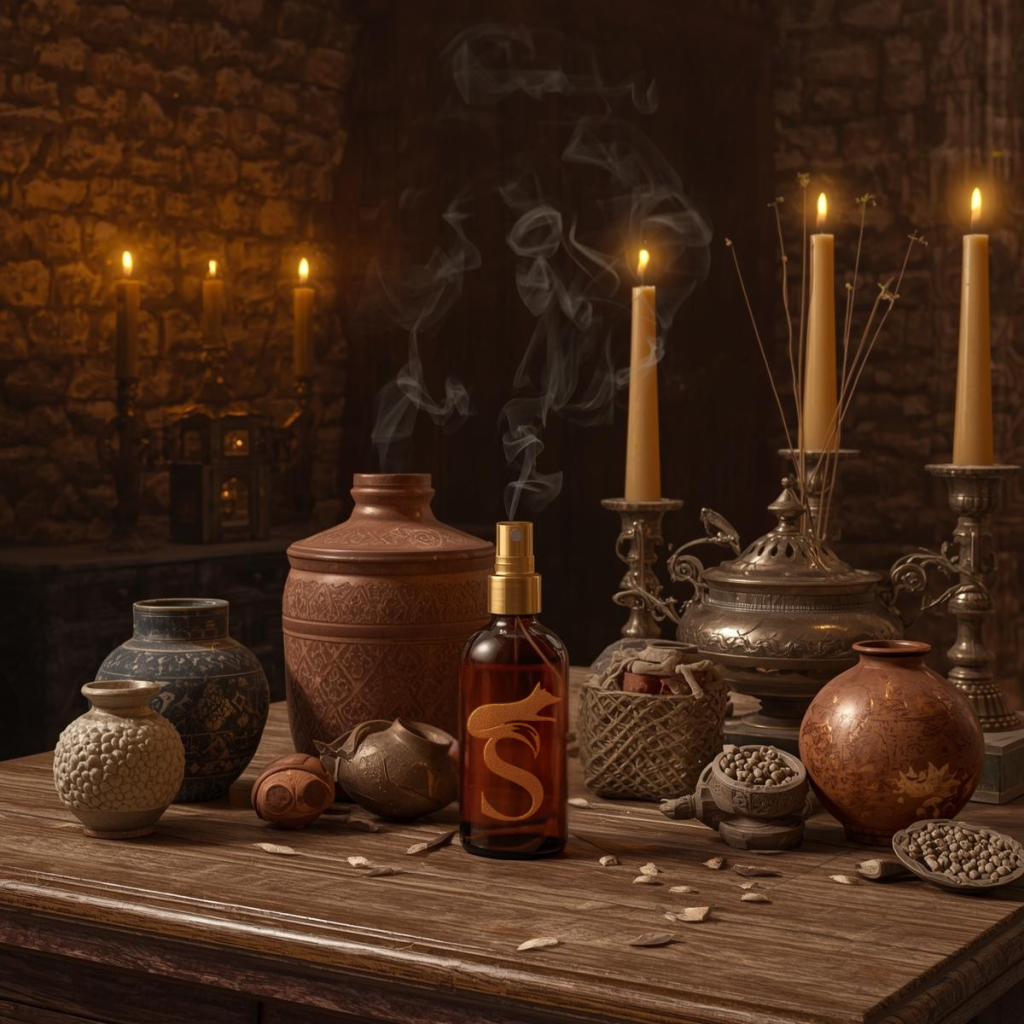
- Aromatic sprays that help purify the space
- Aura-balancing formulas infused with crystals
- Wearable aromatherapy badges that can be carried throughout the day—all designed with different usage formats in mind.
The goal is the same:
- To make the ritual accessible,
- to simplify the practice,
- and to ensure consistency.
Because the answer to the question “Why are rituals effective?” lies not only in their content but also in their regular practice. A ritual that isn’t practiced remains merely theoretical. A practice that can’t be sustained loses its effect. That’s why the Terra di Simana approach is simple:
A ritual shouldn’t be complicated. It should fit into the flow of life. And most importantly, it should be usable anytime, anywhere.
What Is a Ritual? An Example of a Daily Ritual (3-Minute Reset)
Pause in the middle of a hectic moment. When your mind wanders, your energy drops, or you lose focus…
This short ritual is designed to help you regroup throughout the day.
First, slow down.
Gently apply Drops of Serenity to your surroundings. Let the scent spread. Take a deep breath and consciously inhale that aroma. The goal at this stage is to slow down your mind and quiet your inner voice.
Now return your attention to your breath. Take deep breaths and exhale slowly for 1 minute. Keep your focus solely on your breath. This calms the nervous system and brings the mind to a single point.
Then move on to your body. Gently apply the Kutan Pulse Oil to your pulse points and your navel. This point is the center of the body. As you apply it, you’ll feel centered, and your energy will stabilize.
And now, carry the ritual into your day.
Remove the Joy Keeper Wearable Aromatherapy Pin from its packaging and attach it to your chest. This way, the ritual isn’t limited to just that moment—it continues throughout the day.
The total duration is just 3 minutes, but its effect lingers in your mind, body, and energy for much longer. Because the right ritual begins quickly but spreads its effect over time.
The Power of Ritual: The Place of Ancient Wisdom in Modern Life
Rituals are not legends of the new age. They are as old as humanity itself.
As long as humans do not change, the need for rituals will not disappear.
Because the human mind has functioned the same way for centuries: it becomes scattered in the face of uncertainty, regains its composure through repetition, and finds balance through sensory experiences.
Today, science clearly demonstrates this as well. It is now known that repetitive behaviors create a sense of control in the mind, aromatic stimuli affect mood through the limbic system, and rhythmic sound and breathing regulate the nervous system.
In other words, a ritual is not a belief system; it is a mechanism for mental and physiological balance.
Nevertheless, modern humans have largely forgotten these simple yet effective tools that have been used for thousands of years. Instead, they have replaced them with faster, more superficial, and often more exhausting solutions. Yet ancient practices remind us of this:
A person can only recover when they pause.
They can only find balance when they repeat.
They can only transform when they feel.
That is why the point is not to return to the past, but to integrate the wisdom of the past into our lives today. We must not simply copy rituals as they are, but understand their essence and make them relevant to our lives.
Because a ritual:
- Orders the mind
- Calms the body
- Focuses the attention
- Brings a person back to their center
And amid the chaos of modern life, we need this simple balancing mechanism more than ever.
In conclusion:
Big changes don’t always come in big steps. Often, a small practice done at the right moment can shift the mind’s direction, the body’s rhythm, and the flow of the day. Sometimes, all you need is not more—just the right action at the right time.
You can follow us on Instagram at @terradisimana, browse all our products on our website, and find answers to questions like “What Is the Aura Ritual?” in our blog posts!