FREE SHIPPING on orders of 4,000 TL or more



Blog
Plants in Shamanic Rituals: What Does Each Plant Do?

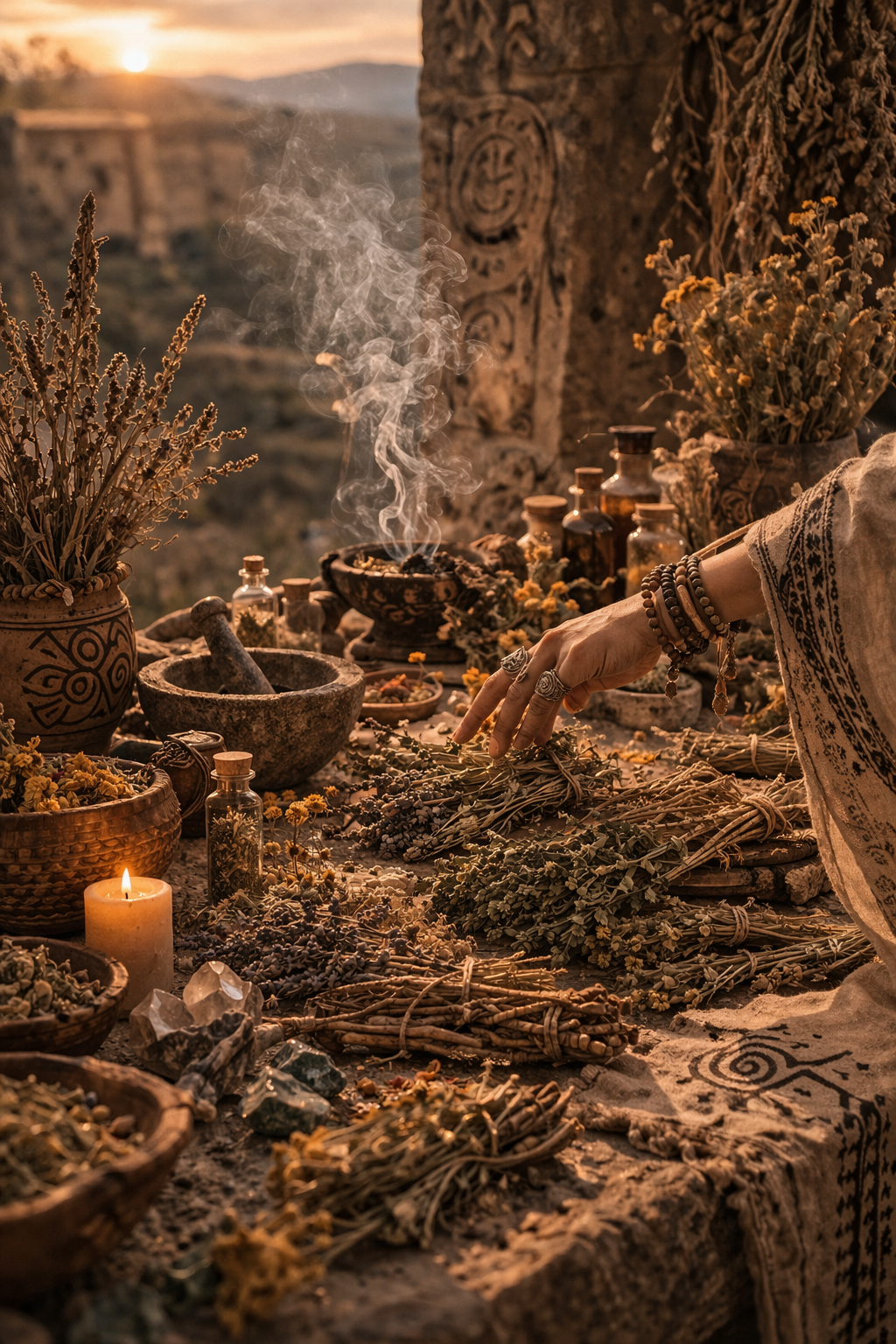
Shamanic Rituals and the Power of Plants
In this blog post, we’ll focus on the topic “Plants in Shamanic Rituals: What Does Each Plant Do?”
Throughout human history, both shamanic rituals and all rituals have been not only part of belief systems but also tools for survival, finding meaning, and establishing balance.
From the very first moment humans found themselves face-to-face with nature:
- encountered events they could not explain
- Faced fear and uncertainty
- Sought to make sense of forces beyond their control
What emerged from this process was not merely a belief, but ritual behavior. Shamanic rituals are among the most common forms of this behavior.
Sounds in nature, celestial events, illness, and death… Faced with this unknown, humans did not remain passive; on the contrary, they observed nature, imitated it, and transformed these imitations into repetitive behaviors.
This system is sometimes established to heal a patient, sometimes for protection, and sometimes to connect with a greater power.
Shamanism is one of the oldest and most holistic systems in this regard. A shaman is not merely a religious figure; they also serve as a healer, mediator, observer, and practitioner.
Within the community, they take on responsibilities such as treating illnesses, communicating with spirits, and conducting rituals. One of their most important tools in this process is plants.
Plants in shamanic practices:
- Healing the body
- To transform the mind
- To enhance the effect of the ritual.
In some cultures, these plants have also been used to alter states of consciousness. However, the goal here is never escapism; rather, it is diagnosis, awareness, and transformation.
Although this approach may be interpreted differently from the perspective of modern science, it holds a consistent place within the shamanic system.
Academic studies today also show that, throughout history, shamans have been recognized not only as mystical figures but also as the first healers and plant experts.
For this reason, the use of plants in shamanic rituals is not a random practice; it is a system of knowledge based on observation, experience, and transmission. And at the heart of this system lies a single truth: Human beings are not separate from nature. As they strive to understand nature, they come closer to understanding themselves.
Why Are Plants Used in Shamanic Rituals?
In shamanic traditions, plants are not used randomly, but rather for specific purposes and in a systematic manner.
1. Healing and Restoring Balance
In shamanism, illness is not viewed merely as a physical problem. It is often interpreted
as a disruption of the balance between humans and nature. Therefore, the healing process involves:
- Supporting the body
- Calming the mind
- Restoring emotional balance.
Throughout history, shamans have been known as “herbalists” and “healers” and are recognized as the first folk healers who worked with plants.
2. Purification and Energy Cleansing
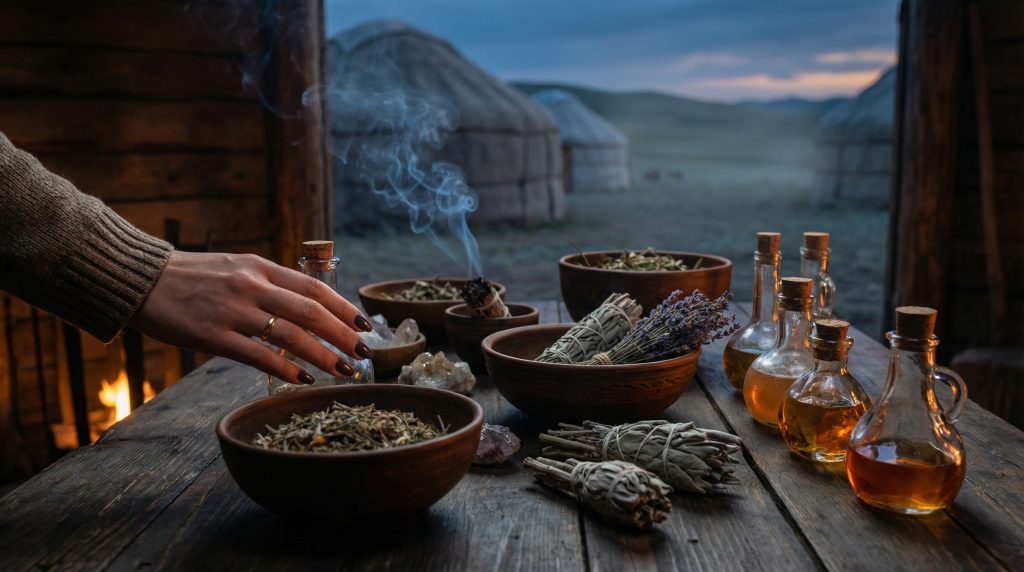
In shamanic practices, the most common use of plants is for purification and space clearing. One of the most common methods is the burning of plants. The main plants used are:
- Juniper → To dispel negative influences and cleanse the space
- Harmala (Peganum harmala) → Protection and purification
- Sage → Mental and energetic cleansing
- Cedar / resins → Dispelling heavy energies
These methods are used for cleansing spaces, purifying individuals, and preparing ritual spaces.
Smoke is not merely a physical process; it is seen as the gateway to the ritual. These practices are still alive today in Anatolia.
3. Herbal Waters and Blends
Plants are not only burned; they are also used in combination with water.
- Herbal Decoctions
- Hydrosols
- Ritual waters are frequently used in shamanic practices.
These methods are used for body cleansing, space clearing, and emotional relief. Water acts as a carrier here, absorbing and dispersing the plant’s effects.
4. Application with Oils and Plant Extracts
Another way to use plants is through direct contact with the body. Applying oils to pulse points, the abdominal area, and the soles of the feet calms the body, grounds the mind, and promotes a sense of connection to the earth.
Modern aromatherapy is also based on these applications.
5. Effects on Consciousness and Perception
In some shamanic traditions, plants have been used to alter states of consciousness.
For example:
- Ayahuasca
- Peyote
- Datura (in high doses)
These plants have been used not for recreational purposes, but for diagnosis, awareness, and insight.
The Common Thread in Shamanic Methods
All these practices share the same common goal:
- To support the body
- To regulate the mind
- To balance energy
- And, most importantly, to realign the human being with nature.
Although this approach is not expressed in exactly the same way by modern science today, at its core it aligns with this reality: scent, touch, and rhythmic practices have a direct effect on the nervous system and emotional state.
Scientific Perspective: Is the Effect of Plants Limited to Scent?
The effects of plants used in shamanic rituals today cannot be explained solely by “scent.” Modern science has shown that plants—in various forms—such as scent, smoke, and extracts—produce multi-layered effects.
1. Scent: Rapid Effect via the Limbic System
When essential oils are inhaled, scent molecules travel directly through the nose to the brain’s limbic system.
This region is directly linked to emotions, memory, and stress response.
For this reason, certain plant-based scents:
- Promote relaxation
- Reduce anxiety levels
- May affect mental focus
Aromatherapy literature indicates that oils such as lavender, bergamot, and similar oils can have a regulating effect on stress and anxiety.
2. Smoke: Effects on Microorganisms in the Air
The effect of smoke produced by burning plants is not merely symbolic. Scientific studies show that smoke from certain plants:
- reduce the bacterial load in the air
- inhibit certain microorganisms.
Research has indicated that smoke produced by burning juniper, sage, and resinous plants, in particular, can reduce microbial density in enclosed spaces.
This suggests that shamanic incense practices may serve not only a ritual purpose but also a hygienic and protective function.
3. Plant Extracts: The Effect of Chemical Components
The active compounds found in plants have not only aromatic but also biochemical effects.
For example:
- Flavonoids → antioxidant effect
- Terpenes → regulatory effect on the nervous system
- Phenolic compounds → antimicrobial properties
These compounds:
- Can be absorbed through the skin
- Can enter the body through inhalation
- May exert an indirect effect on the nervous system
Therefore, applying plant oils to pulse points or inhaling them initiates not only a sensory but also a physiological process.
4. Multilayered Effect: Why Are They Used in Rituals?
The reason plants are preferred in rituals is that they can produce not just a single effect, but multiple effects simultaneously.
- Scent → affects emotions
- Smoke → alters the environment
- Touch → activates the body
This combination:
- Regulates the nervous system
- Reduces stress levels
- Alter perception
As a result, the effects of plants are not limited to just a “pleasant scent.” The plants used in shamanic practices are a combination of sensory, chemical, and environmental effects that can now be explained scientifically.
Which Plant Is Used for What?
In shamanic traditions, plants are not chosen at random. Each plant is used for a specific purpose. Modern aromatherapy actually works on the same principle. However, what matters here is not just “what it’s used for,” but in what situation and with what intention it is used.
Lavender → Calms the Nervous System, Soothes the Mind
Lavender is not merely “soothing.” Its primary effect is to calm an overstimulated nervous system.
- It slows the heart rate
- Relieves mental tension
- Facilitates falling asleep
That’s why lavender:
- Overthinking
- Anxiety
- Mental noise.
In shamanic terms, this is described as “lowering the fire of the mind.”
Rosemary → Sharpens the Mind, Clears the Fog
Rosemary, on the other hand, activates the mind.
- It enhances focus
- Reduces mental fatigue
- Supports memory processes
That’s why rosemary:
- Indecision
- Mental fog
- It is preferred in cases of loss of focus.
In shamanic use, this plant is one of the herbs that “opens up vision and awareness.”
Sage → Clears the Space, Dispels Energy
Sage is not merely an incense. Its primary effect is to disperse the sensory and mental energy that has accumulated in a space.
- It changes the atmosphere
- It reduces mental heaviness
- Creates a sense of a “cleansed space”
Therefore:
- After intense stress
- After an argument
- It is used in environments that feel heavy.
Scientifically, it has also been shown that plant smoke can reduce the microbial load in the air, demonstrating that sage’s effect is not merely symbolic.
Bay Leaf → The Plant of Decision and Clarity
Bay leaf has historically been associated with strength and finding direction.
- It helps clear mental fog
- Supports decision-making processes
- Creates a sense of inner clarity
Therefore:
- Indecision
- Loss of direction
- Used in situations of mental confusion.
Rose → Softens the Emotional Realm
In shamanic and aromatherapy systems, the rose is associated with the “heart space.”
But this isn’t a romantic meaning; it relates to emotional regulation.
- It softens emotional rigidity
- It reduces internal tension
- It increases the sense of trust
Therefore:
- Resentment
- Emotional withdrawal
- Used in cases of inner rigidity.
Patchouli → Grounds the Body, Earths
Patchouli’s effect is downward, not upward.
- It slows down the mind
- Increases body awareness
- Creates a sense of “I am here”
Therefore:
- A sense of disconnection
- Excessive mental activity
- It is used in states of distraction.
In the shamanic tradition, patchouli is “the plant that brings a person back into their body.”
The Connection Between Ancient Knowledge and Modern Life
Shamanic practices are built upon the balance that humans establish with nature. When this balance is disrupted, the effect is felt not only in the external world but directly within the person.
This is precisely where the fundamental problem of modern life begins. As humans distance themselves from nature, they begin to lose not only their connection to their surroundings but also their inner balance.
The effects of this disconnect are very clear today:
- Increased stress levels
- Loss of attention and focus
- Mental fatigue
- Inner restlessness.
Scientifically, it is also known that constant exposure to stimuli overstimulates the nervous system, which in turn increases feelings of anxiety and burnout.
The shamanic approach, however, addresses this issue from a different perspective: It is not the person who is broken, but the balance that is disrupted.
Therefore, the solution is not complicated. When a person realigns with nature, the mind and body begin to regulate themselves.
The growing interest today is not a new trend; it is the rediscovery of forgotten knowledge.
Modern Rituals: More Practical, Same Effect
Rituals in the past:
- Required specific spaces
- Involved lengthy preparation processes
- Required time and discipline
Today’s lifestyle, however, makes this unsustainable. Yet the need remains. That’s why rituals haven’t disappeared—they’ve simply changed form.
Modern rituals:
- Can be performed in a shorter amount of time
- Can be integrated into daily life
- Have a repeatable and sustainable structure
The goal is no longer to perform lengthy rituals; it is to embed the effect into daily life.
In this way, the ritual:
- Becomes accessible
- Can be practiced regularly
- Produces real benefits
As a result, modern rituals do not simplify ancient knowledge; they make it livable. And this transformation takes rituals out of the realm of the past and turns them into one of today’s most effective tools for balance.
Shamanic Plant Guidance
Ever since humans began defining themselves solely through their minds, they have grown weary. Because the mind is burdened with more than it can bear on its own. It is a structure that constantly thinks, analyzes, and tries to solve problems—yet at the same time, it creates an inner world that is becoming increasingly disconnected, scattered, and restless.
Yet humans have never been merely the sum of their minds. They were a whole—comprising their bodies, their senses, their intuition, and the connection they forged with nature.
Shamanic traditions were the bearers of a wisdom that preserved precisely this wholeness. In these traditions, plants were not merely objects to be used; they were seen as guides that reminded humans of who they truly are.
Working with a plant was not about consuming it, but about allowing its influence to take hold. When you inhale a scent, your mind slows down. Your body relaxes. Your emotions shift.
When a plant is burned, it’s not just smoke that rises; the atmosphere changes. It’s as if an invisible weight lifts.
Today, science can explain these effects: volatile compounds affect the nervous system; scent regulates emotions through the limbic system; and plant smoke can alter the structure of the environment.
But this knowledge isn’t new. It’s simply being rediscovered.
Because, in the modern world, we often feel alone. Fatigue, feeling trapped, a loss of meaning… We think these feelings belong only to us.
But that’s not the case. There were those who walked this path before us—
people who struggled, searched, fell, and got back up again…
They left behind a body of knowledge. There is a path. There is a quest for balance. And we are not alone on this path.
That wisdom is still here. Within nature, within rituals, within plants…
Our plant guides are just one of these powerful and transformative sources. They don’t tell us what to do; instead, they remind us what to feel.
Perhaps through a scent, perhaps through a touch, or perhaps at a moment you least expect…
And sometimes, this remembrance comes from a simpler place than you might think—even over a cup of hot cocoa.
The farther a person drifts from nature, the more weary they become. The closer they get to nature, the closer they get to themselves.
And perhaps the solution was never complicated to begin with.
Slowing down, feeling, and reconnecting…
That’s all there is to it. Because balance isn’t found outside—
it’s remembered within.
You can follow us on Instagram at @terradisimana, browse all our products on our website, and find answers to questions like “Plants in Shamanic Rituals: What Does Each Plant Do?” in our blog posts!