FREE SHIPPING on orders of 4,000 TL or more


Blog
Aromatherapy for Anxiety: Soothing Essential Oils and Natural Methods


Some days, the human mind remains like a window left open. From the outside, everything seems normal; but inside, the wind never stops blowing. One thought arrives, summoning another. The heart races. The chest tightens. Night falls, the world grows silent; yet the mind, at that very moment, amplifies its own noise.
This is how anxiety is sometimes experienced: not as a thought, but as an invisible tension that settles into the body.
Today, anxiety and anxious thoughts are among the most common companions of modern life. That’s why many people ask: Does aromatherapy really work for anxiety? Scientific data suggests that aromatherapy can play a supportive role, particularly in certain situations; but this effect is neither the same for everyone nor a sufficient solution on its own. A 2023 systematic review reported that essential oils may be associated with a reduction in both situational and chronic anxiety. A 2020 meta-analysis also suggests that aromatherapy can reduce anxiety symptoms; however, it emphasizes the need for further research regarding appropriate dosage, oil selection, and method of use.
Why Are Anxiety and Worry So Common?
Our bodies are ancient, but our lives are too modern.
Notifications, screens, speed, uncertainty, decision fatigue, a constant state of arousal… Modern life leaves very little opportunity for the nervous system to rest. Many people think of anxiety as merely a mental phenomenon; yet anxiety is often experienced in the body.
- Clenching the Jaw
- Tensing the shoulders
- Forgetting to breathe
- A feeling of pressure in the chest
- The mind going round and round in circles
- Being unable to relax
- Being unable to fall asleep
At this point, aromatherapy isn’t a miracle cure for anxiety; rather, it takes on meaning as a complementary approach that can help slow the body down a bit, soften the environment, and send a reassuring signal to the nervous system. Modern approaches also view aromatherapy within this framework: not as a substitute for medical treatment, but as a method that can support well-being in certain situations.
How Can Aromatherapy Help with Anxiety?
It is more accurate to consider the potential effects of aromatherapy on anxiety on two levels:
1. Sensory regulation through scent
The olfactory system is closely connected to the brain’s regions associated with emotion and memory. For this reason, certain scents can quickly evoke feelings of relaxation, slowing down, or emotional softening in a person. Comprehensive reviews published in 2023 indicate that essential oils may have effects on the nervous system; however, these effects vary depending on the oil used, the method of application, and the individual.
2. The Power of Ritual
Aromatherapy is sometimes about more than just the oil. Opening a bottle, pausing for a moment, taking a deep breath, dimming the lights, telling the body, “We can slow down now”…
The nervous system recognizes these repeated, reassuring cues. That’s why aromatherapy for anxiety isn’t just about chemistry; it’s also about ritual, sensory context, and the structure of habits.
The 7 Most Popular Essential Oils for Anxiety and Anxious Thoughts
Let’s be honest here: not every oil is suitable for everyone. A scent that works well for one person may feel overpowering—or even unsettling—to another. Still, among the oils most frequently associated with relaxation and calm in aromatherapy literature, the following stand out:
1) Lavender
Lavender is one of the most frequently mentioned oils when it comes to aromatherapy for anxiety. The NCCIH notes that while some studies on lavender preparations have shown beneficial effects on anxiety, the quality of the research varies. A 2019 systematic review also found stronger results specifically for oral lavender preparations, while data for inhalation and massage were more heterogeneous.
2) Roman Chamomile
It has a soft and soothing aroma. It can be a gentler option, especially in the evening, for anxiety accompanied by physical tension.
3) Cedarwood
With its dry, deep, and earthy scent, cedar can create a sense of “grounding.” It is considered among the oils that set the mood, imparting a sense of weight and calm.
4) Lavender
Due to its floral yet non-overpowering nature, it can provide a soothing background aroma during emotional fluctuations. This beautifully scented oil is wonderful for stress-induced anxiety and emotional ups and downs. It’s a great choice to help rebalance the mind.
5) Clary Sage Oil
This musky, bittersweet floral oil is known for its euphoric, mood-lifting effect; it is also a soothing sedative that encourages the body to regenerate.
6) Ylang-ylang
It is one of the aromas that can be used for emotional blockages, physical tension, and feelings of inner rigidity. However, if used too intensely, it may feel overwhelming for some people.
7) Citrus family
A 2023 systematic review and network meta-analysis reported that the essential oil of Citrus aurantium L., in particular, stands out for its anxiety-reducing properties. This is important because while people often think only of lavender, the citrus family also holds significant potential for emotional relief. For example, bergamot oil is known for its soothing and calming properties and is even referred to as “Nature’s Prozac.”
How to Use Aromatherapy for Anxiety?
The real question here is: Which method of use truly fits your lifestyle?
After all, no one’s life consists of sitting by a diffuser all day.
1. A Short-Term Smelling Ritual
When anxiety flares up during the day, briefly inhaling a scent you love—one that creates a sense of calm—can be helpful. There are also meta-analyses suggesting that brief inhalation may be beneficial for preoperative anxiety in clinical settings.
2. Portable Aromatherapy Use
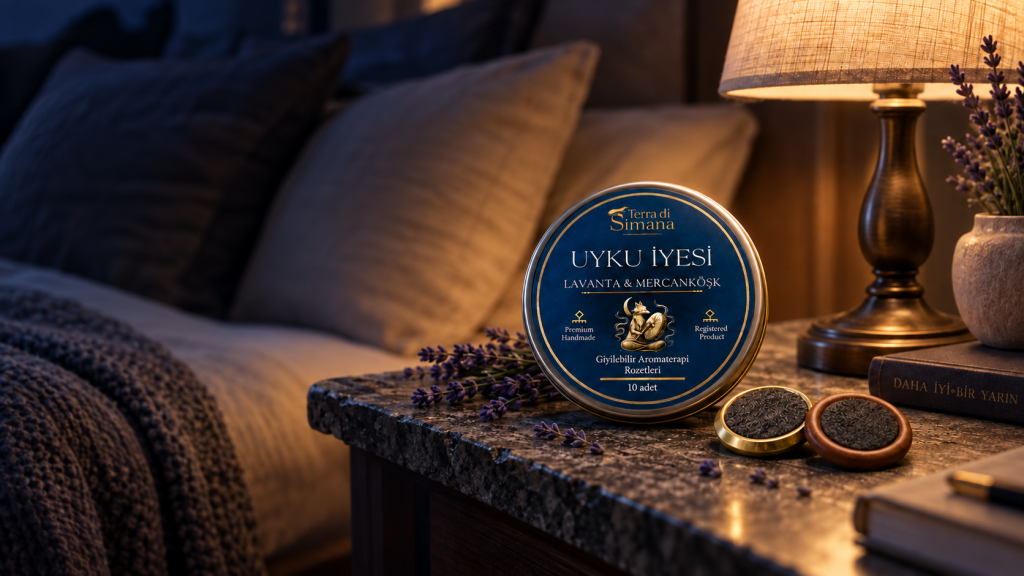
Professional aromatherapy resources like Base Formula frequently recommend “sniffy sticks,” aromatic inhalers, and solutions for use throughout the day. This is a valuable idea because modern life demands practicality. The same logic makes the wearable aromatherapy approach meaningful as well: keeping the scent in a person’s immediate surroundings at a controlled, lower intensity. This may be particularly practical in the office, while traveling, before meetings, or in crowded environments.
3. Evening Spray and Wind-Down Ritual
Anxiety often becomes more pronounced at night. That’s why aromatic sprays used in the evening can be a wonderful tool for softening the room’s atmosphere and signaling to the body that “the day is over.” The power here lies not only in the scent but also in the transition ritual.
4. Aromatherapy Massage
The NCCIH’s summaries on anxiety include data suggesting that massage with lavender oil may be effective; however, it’s unclear how much of this effect comes from the lavender itself and how much from the touch and massage. This actually highlights an important point: sometimes it’s not a single element that’s healing, but the entire experience.
5. Think About the Boundary, Not the Bath
Not everyone has a bathtub. Not everyone has free time, either. That’s why we need to think about aromatherapy not in terms of an “ideal ritual,” but in terms of real life. A few moments for deep breaths can sometimes be just as valuable as a long ceremony.
Are There Scents That Can Increase Anxiety?
Yes. And it’s important to talk about this.
Not every essential oil is soothing for everyone. Scents that are too stimulating, too sharp, or that evoke negative associations can, in some cases, create more restlessness rather than relaxation. For example, very strong peppermint, overly intense rosemary, or certain overpowering blends can create a sense of excessive “alertness,” especially during sensitive times.
Aromatherapy is a bit like a personal language. Not every body perceives the same scent in the same way.
Is Aromatherapy Enough on Its Own?
No. Most of the time, it is not enough. And this needs to be stated clearly.
If you’re experiencing severe anxiety, panic symptoms, functional impairment, insomnia, constant hypervigilance, or physical symptoms, aromatherapy is not a method designed to resolve these issues on its own. It should be considered alongside professional psychological support, psychiatric evaluation when necessary, establishing a sleep routine, reducing caffeine intake, breathing exercises, and physical movement. Modern aromatherapy approaches also clearly state that complementary approaches should be used alongside—not in place of—medical care.
Aromatherapy is a small but effective part of the bigger picture here.
Safe Use: What Should You Keep in Mind When Using Essential Oils for Anxiety?
- Essential oils are highly concentrated substances; they must be properly diluted before applying them directly to the skin.
- Extra caution is required for children, the elderly, pregnant women, and people with chronic illnesses.
- Random oral use is not considered safe.
- Personal sensitivity and scent tolerance must always be taken into account.
- Just because something is “natural” does not automatically mean it is “harmless.” The NCCIH emphasizes this point in particular.
How Do We Approach Aromatherapy for Anxiety at Terra di Simana?
We view anxiety not merely as mental noise, but as a state of tension that settles into the body. This is because anxiety often manifests in the shoulders, jaw, chest, and breath.
That’s why we see aromatherapy as much more than just a pleasant scent; we view it as a small space of support designed to help a person reconnect with themselves throughout the day.
Sometimes this takes the form of a gentle atmospheric blend used in the evenings. Sometimes it’s a portable aromatic space to carry with you throughout the day. And sometimes it’s a quiet threshold that softens the mind’s rigidity, even if just a little.
The result: Even if anxiety doesn’t disappear immediately, it will remind you that everything is okay.
Some emotions don’t just walk out the door. Some merely lower their voice. Some begin to take up less space in the body.
Aromatherapy sometimes does exactly that. It may not erase anxiety in an instant, but it can soften its harshness. It can help you breathe a little deeper.
It can make the room, the evening, and the body a little more livable.
So, if we’re trying to return to our natural state, why not use nature’s own therapy to help balance our anxiety?
You can follow us on Instagram at @terradisimana. Stay up to date on all the latest developments.
References
- Tan L et al. 2023. Essential oils for treating anxiety: a systematic review of randomized controlled trials and network meta-analysis.
- Gong M et al. 2020. Effects of aromatherapy on anxiety: A meta-analysis of randomized controlled trials.
- NCCIH. Anxiety and Complementary Health Approaches.
- NCCIH. Lavender.
- Guo P et al. 2020. The effectiveness of aromatherapy on preoperative anxiety in adults.
- Donelli D et al. 2019. Effects of lavender on anxiety: A systematic review and meta-analysis.
- NCCIH. Aromatherapy.