FREE SHIPPING on orders of 4,000 TL or more



Blog
Simana’s Diaries – 25 – The Spirit of the Hunt 2

As the hunt began, the first clues revealed themselves easily: fresh footprints lightly embedded in the soil, snapped slender twigs, bark scraped away by friction… Everything pointed the way. The hunters followed these signs carefully, matching their steps to the rhythm, regulating their breaths. But as they advanced, the tracks began to fade; first they grew indistinct, then changed direction, and finally vanished as if pulled from within the earth. The wind scattered the scent rather than carrying it; the birds fell suddenly silent, creating a void; and that invisible current between the trees slowed the hunters’ progress without stopping them. The impatience within the hunters reflected in the stiffness of their steps; their gazes sharpened, their breaths grew shorter. But the forest, rather than answering this call, simply continued to listen.
Unwilling to accept that the tracks had vanished, the
hunters pressed deeper into the woods; each tried to reorient himself by holding the last sign he’d seen in his mind, bending down to discern the slightest crack or the faintest indentation in the hardening surface of the ground, and straining his ears for the faintest rustle carried by the wind. Arrows were ready, bows drawn, breaths held; but the forest offered nothing that would give it away. For a moment, a shadow in the distance seemed to stir, then vanished; a branch was thought to have snapped, but as the wind shifted, that sound, too, faded away. Eyes searching for tracks grew weary, noses following the scent were led astray; as the hunters tried every path they knew, the trail retreated. Time dragged on, the sun rose, but there was no response.
Amid this effort, an invisible resistance slowly became apparent; it was as if the forest wasn’t stopping those who passed through it, but wasn’t claiming their progress as its own either. The grasses crushed beneath their footsteps straightened again; the ground they stepped on left no trace, and each step they took seemed to disperse, erasing the meaning of the one before. The determination within the hunters gave way to a silent tension; no one voiced it openly, but everyone felt the same thing: Here, not only had the object of their search vanished, but the seekers themselves had begun to lose their way. And in that moment, the silence within the forest ceased to be mere emptiness and transformed into a will that delayed the answer.
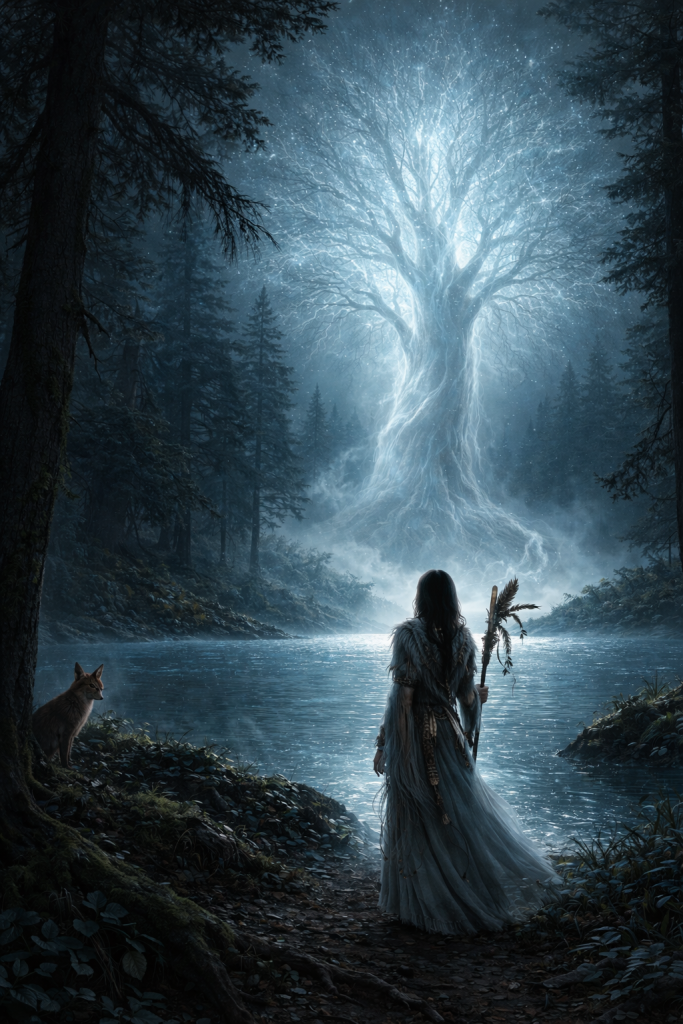
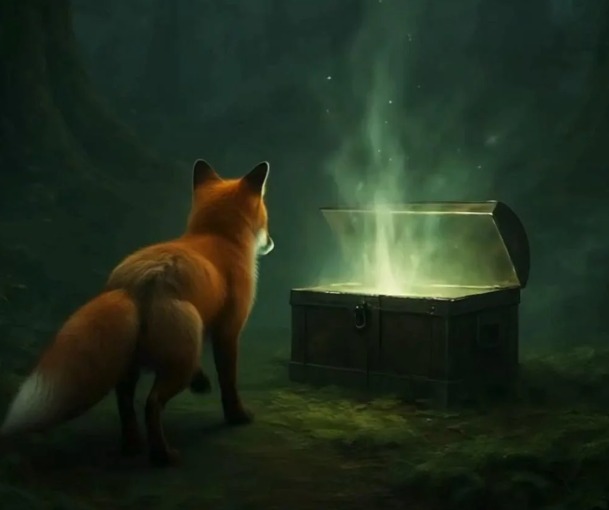
Just then, one of the shadows among the trees parted; a fox, gliding like a slender, crimson line, emerged from the silence and came to a halt in the middle of the path. It was neither timid nor defiant; it was simply looking—yet that gaze resembled less the cautious eye of an animal than the revelation of a direction. Its tail swayed slowly without touching the ground, its head tilted slightly to the side; then it took a step, paused, and looked again without retreating. In that gaze, Simana saw the single meaning where the trails that had just vanished, the scattered scents, and the silent birds all converged. The path was not closed, but the direction had changed. Perhaps this was not a punishment, but a warning.
Simana raised her hand; the footsteps ceased one by one. “It is not permitted,” she said. Her voice neither rose nor fell, but it reached everywhere like the smoke from a fire. The words hung in the air among the trees for a brief moment. One of them, frowning, whispered, “The trail was right here… Should we go a little further?” Another added, without loosening his bow: “The ritual is complete; it’s still too early to turn back.” Simana did not take her gaze off them; for she saw the source of the objection in the haste hidden behind their words. “The path is not forced,” she said, “The path is observed, and ended when necessary.”
The group was not convinced, but just then, the wind suddenly shifted direction. The scents that had just been dispersing gathered at a single point, then vanished as if pulled back by an invisible hand. A faint hum passing through the branches ceased for a moment; then, from above, from an unseen place, a single branch broke off and fell to the ground. Neither the leap of an animal nor the flutter of a bird’s wings accompanied this fall; the branch seemed to have been left to its own devices. At the same moment, the fox moved forward not from where it had come, but from another direction, took two steps, then stopped again; this time its gaze was shorter, more decisive, and it blended into the shadows.
The hunters looked at one another. No one spoke. Their bows went slack, and their steps retreated. Some signs require no explanation; they are simply accepted. And that day, the forest had shown its boundary.
When
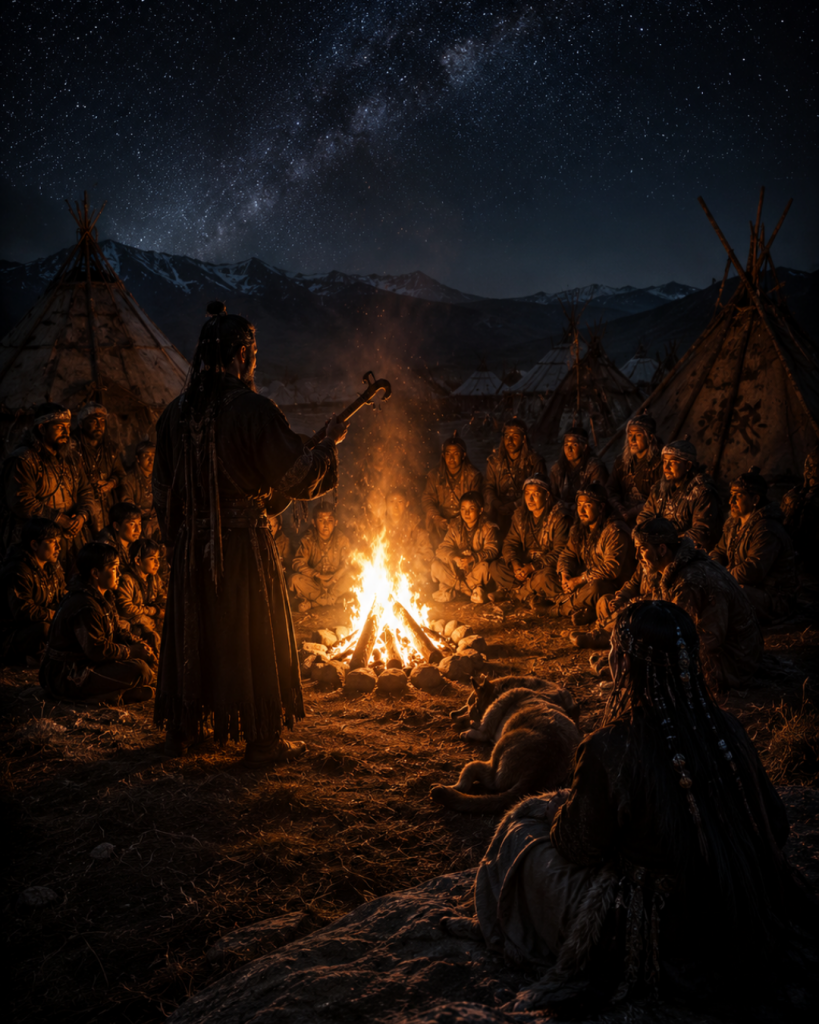
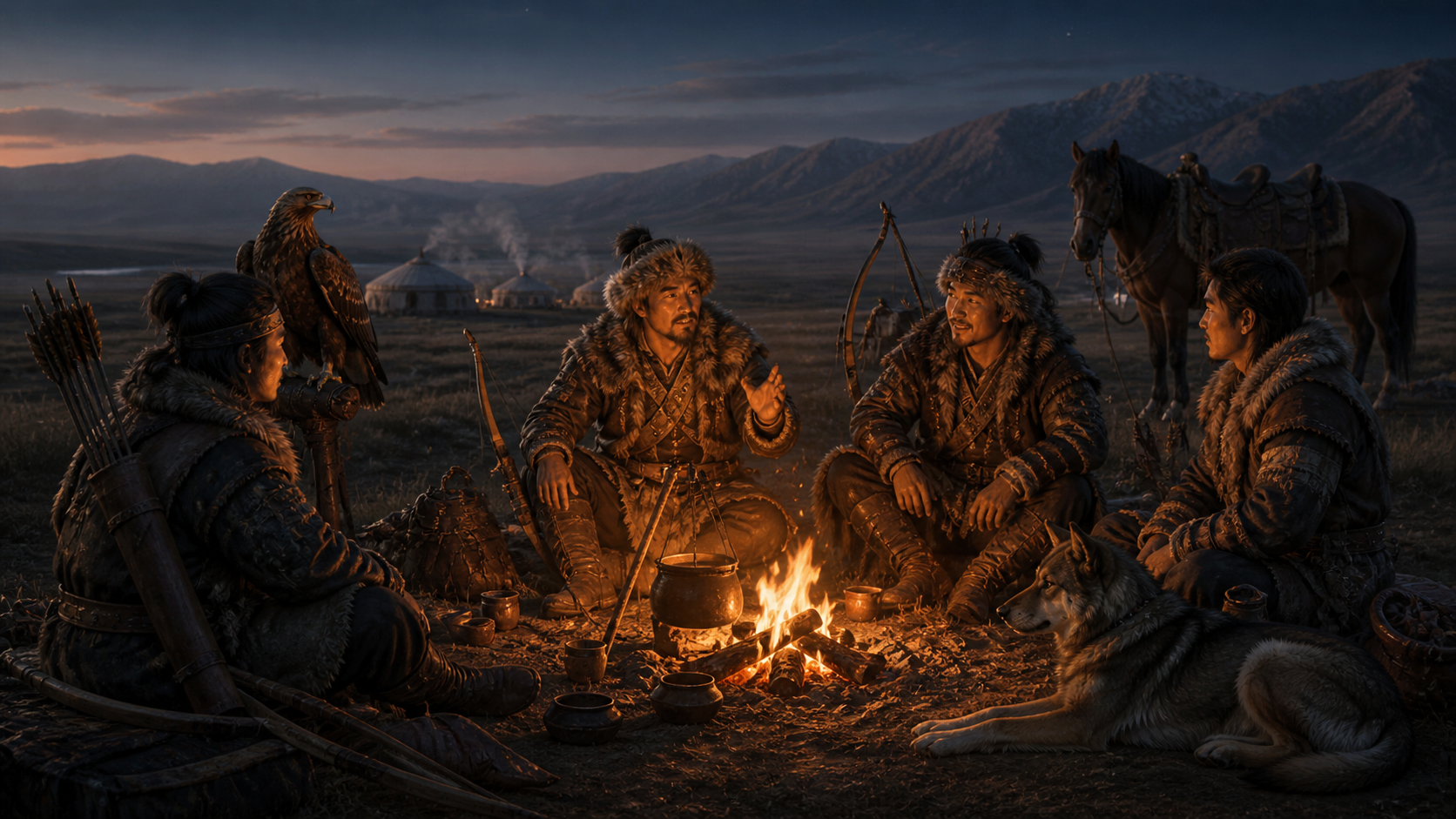
night fell, the fire was rekindled; but this time, the faces of those gathered around the flames bore not the weariness of returning from the hunt, but the weight of an unspoken sign. No one spoke aloud; everyone was trying to find in the darkness what they had missed somewhere during the day.
As the flames rose, the shadows grew; as the shadows grew, their gazes deepened. After a while, one of the older hunters paused as he held out the meat in his hand toward the fire; he realized he had set aside the best part for himself, while what he had left for the offering was only the unwanted portion. That small difference loomed large in that moment. Then another recalled that he had left the stone in front of the obo as he set out, but had magnified the spoils in his mind. Another admitted that he had felt relieved that the bear’s name had not been mentioned, yet confessed that deep down, he had looked at it as if it were merely an animal. The words were few, but each found its place; for that night it became clear that what was missing was the balance of intention. The weight of what was to be taken had outweighed what was to be given.
Simana did not speak; for now, the words were coming from within them. Gathered around the fire, each accepted their share. The offering was not merely the meat that had been left; one also had to leave behind one’s own share within oneself. That night, salt was shared before the meat, words before the salt, and each resolved to leave behind the excess within themselves for the next day. The smoke from the fire rose straight up, and the stars twinkled more rapidly; it was as if the forest had made it clear that this time, it was listening.
The next morning, they walked the same path again; but the purpose of their steps had changed. The stone left before Obo was, this time, a remembrance. The salt and bread left at the forest’s threshold were placed not out of obligation, like the repayment of a debt, but with the intention of participating in a balance. The forest offered no resistance as it welcomed them in; the light filtering through the branches was brighter, and the wind did not shy away from carrying the scent.
This time, the tracks did not hide themselves. The tracks on the ground were clear, and the broken branches marked the path. The hunters did not rush; they matched their steps to the rhythm of the tracks and did not hold their breath. Shortly afterward, a deer appeared; it did not flee, nor did it challenge them. It simply stood still and looked. There was no fear in that gaze; for the encounter was no longer a forced chase, but an accepted meeting. An arrow was fired; the animal fell to the ground. The hunter bent over the animal’s head. With a brief but heartfelt address mingled with his breath, he apologized and gave thanks; for what was taken was not merely a body, but the path and right of a living being.
The first piece of meat was cooked right where the animal had fallen; that first bite was considered a portion set aside to send the taken life off in peace before it became a blessing to be carried back to the camp, and delaying this portion meant establishing balance in words only while postponing it in action.
The
fire was quickly built; as the thin branches crackled and burned, a small piece of meat was set aside; this piece was neither chosen from the fattest part nor, at the very least, torn from exactly where it should have been, and it was placed upon the flames. As the smoke rose, it first touched the ground, brushed against the trunks of the trees, then dispersed with the wind; and thus the hair offered to the lord of the forest stepped out of words and blended into existence.
The bones were gathered carefully, without haste; no piece was broken at random, no joint was separated haphazardly. It was believed that the bone is the soul’s final bond with the world, and if this bond is severed recklessly, the path becomes obscured.
Then the return began. As they crossed the forest’s threshold, no one looked back, yet everyone felt that something within them had found its place; for what had been done on the way there was, in a similar way, repeated inwardly on the way back. What was taken had been balanced by what was given.
When they reached the camp, the spoils were not simply laid out like a pile of accumulated meat; first, a fire was lit, and then the distribution began. This distribution was not done by eye, but according to a measure established over the years. Priority was given to the elders; for the life they carried belonged not only to their own bodies. The share set aside for the children, though small in appearance, held great significance; for that share was not merely for sustenance, but for the memory of a life in the making. Women, men, and households were considered one by one; no one’s share was taken in excess, and no one’s was left wanting. Just then, a portion was also extended to a stranger passing by the encampment—this was a continuation of an ancient tradition. That day, everyone knew that what was being taken was not merely meat; what was being taken was the burden of a life, and that burden would not be lightened unless it was shared.
Simana watched this sharing as she sat by the fire. She did not see the meat being divided, but rather how responsibility was distributed; she realized how the burden of a life was balanced among their hands. And in that moment, the wisdom of the third level touched the earth once more: To live was not merely to breathe in and out. To live was to know the worth of everything you touched, to be able to carry what you took, and to lighten the world’s burden—even just a little—wherever you passed.