 FREE SHIPPING on orders of 4,000 TL or more


Blog
What Is the Fall Equinox? What Happens on September 23?

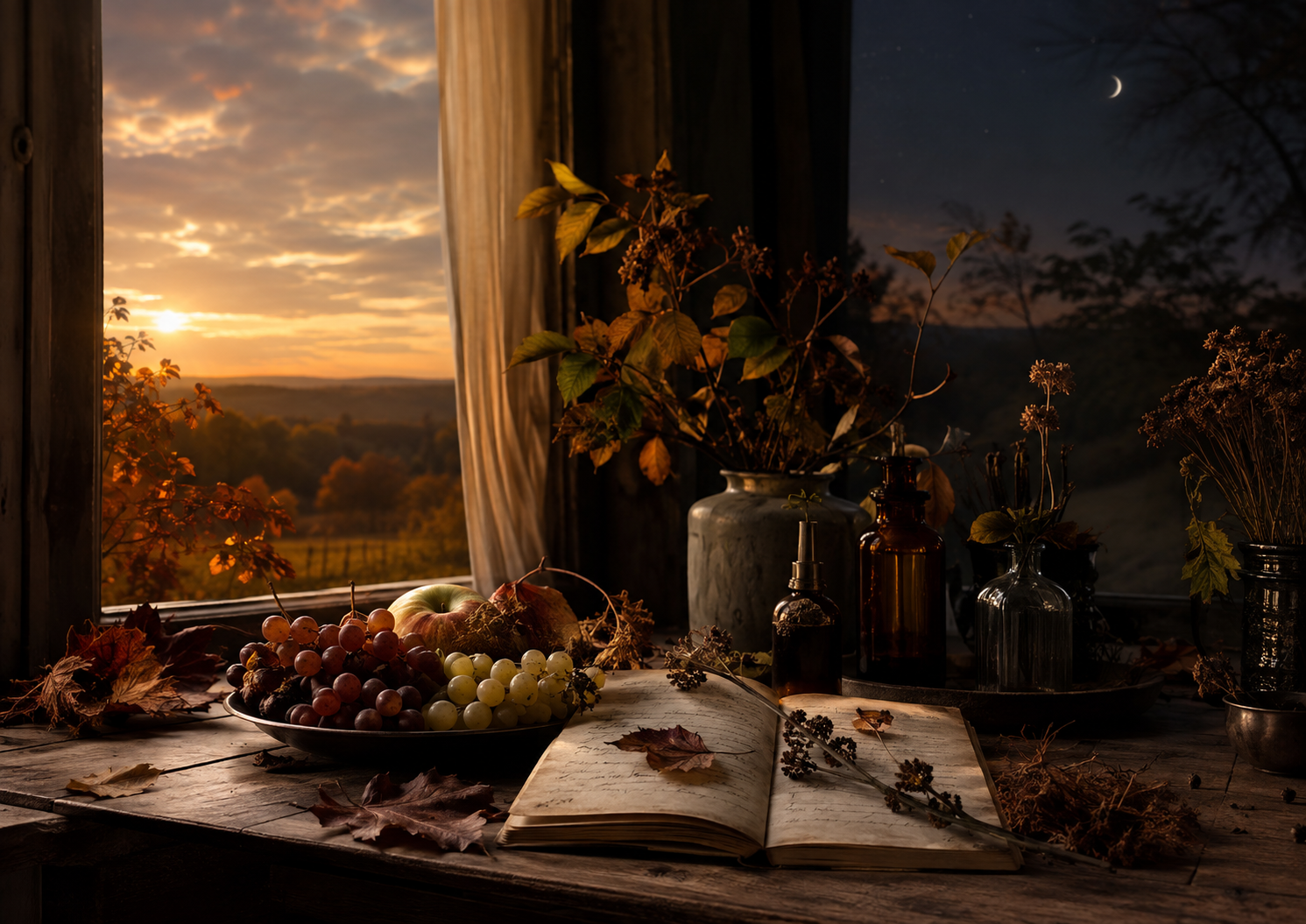
What Is the Fall Equinox? Are Day and Night Truly Equal on September 23?
Every year, toward the end of September, an invisible yet extremely precise threshold is crossed in the sky.
The long days of summer begin to fade. The sun sets earlier. Shadows lengthen. The Northern Hemisphere slowly moves toward the darker half of the year.
This astronomical threshold is the fall equinox.
In 2026, the fall equinox will occur on Wednesday, September 23, at 3:05 a.m. Turkey time. At that moment, the Sun will cross the celestial equator from north to south, marking the beginning of astronomical fall in the Northern Hemisphere. In the Southern Hemisphere, that same moment will mark the beginning of spring.
But there’s a little myth that’s been repeated for years: “On September 23, day and night are exactly 12 hours each.”
Actually, that’s not true. The equinox is a bit more interesting than that.
What is the equinox?
The word “equinox” comes from the Latin words aequus—meaning “equal”—and nox—meaning “night.”
It occurs twice a year:
- The March equinox
- September equinox
During the September equinox, the Sun’s apparent position in the sky crosses the celestial equator from north to south.
The Earth’s axis of rotation is tilted by approximately 23.5 degrees. This axial tilt is the fundamental cause of the seasons. At the June solstice, the Northern Hemisphere is tilted toward the Sun, while at the December solstice, it is tilted away from the Sun.
At the equinox, however, neither hemisphere is distinctly tilted toward the Sun. Sunlight is distributed more evenly across both hemispheres. In NASA’s space observations, this phenomenon can also be seen in the line separating the Earth’s light and dark sides, which extends in a north-south direction near the poles.
To put it simply: Solstices represent the extremes, while equinoxes represent the transition points.
When is the Fall Equinox in 2026?
For Turkey, the 2026 fall equinox is calculated to occur on September 23, 2026, at 3:05 a.m. In Coordinated Universal Time (UTC), this moment is September 23, 2026, at 00:05 UTC.
Therefore, the statement sometimes seen online—“Fall begins on September 23 every year”—is not entirely accurate.
Depending on the year and time zone, the September equinox can fall on September 22, 23, or, more rarely, September 24.
For example, in Turkey:
- September 22 in 2025,
- September 23 in 2026,
- and in 2027, it will again be September 23.
Are night and day truly equal on September 23?
Here’s one of the most fascinating details about the equinox.
No, in most places, they aren’t exactly equal.
During the equinox, the light and dark halves of the Earth are geometrically balanced. However, the duration of what we measure as “daytime” is not determined solely by this geometry.
There are two main reasons for this.
1. The atmosphere refracts light
Even when the Sun has actually dipped below the horizon geometrically, we continue to see it for a few more minutes because the atmosphere refracts the light.
For the same reason, we can see the upper edge of the Sun in the morning even before it has geometrically risen.
This slightly extends the duration of daylight. NOAA also notes that atmospheric refraction is one of the main reasons why day and night are not exactly equal at the equinox.
2. The Sun is not a point
The Sun appears as a disk in the sky.
Sunrise begins when the Sun’s upper edge—not its center—appears on the horizon; sunset ends when the upper edge has completely disappeared.
This makes the day appear a few minutes longer.
How many hours will daylight last in Istanbul on September 23, 2026?
Let’s look at a concrete example. On September 23, 2026, in Istanbul:
Sunrise: approximately 6:52
a.m. Sunset: approximately 6:59 p.m.
The duration of daylight is 12 hours, 7 minutes, and 30 seconds.
So even on the day of the equinox, the day is about 7.5 minutes longer than the night.
In Istanbul, the length of daylight doesn’t come very close to 12 hours until a few days later:
- September 24: 12 hours, 4 minutes, 48 seconds
- September 25: 12 hours, 2 minutes, 5 seconds
- September 26: 11 hours, 59 minutes, and 23 seconds.
This date, when day and night are observed to be closest to 12 hours, is sometimes called “equilux.”
Therefore, the equinox and “exactly 12 hours of daylight” are not the same astronomical event.
In our view, this detail makes the equinox not less, but more beautiful. Nature is not as simple as a mathematical slogan.
Where does the Sun rise during the equinox?
Another interesting feature of the equinoxes is that, in most parts of the world, the Sun rises very close to the east and sets very close to the west.
On other days, the Sun’s rising and setting points shift north or south throughout the year.
The equinox is one of the distinct thresholds in the middle of this movement. NOAA also notes that during the equinox, the Sun rises in the east and sets in the west in most places.
So, if you’re in a place with a clear horizon around September 23, you can make a simple observation: Notice where the Sun rises in the morning and where it sets in the evening.
Sometimes the best way to understand the equinox is to read the sky.
Does fall really begin on September 23?
Here, too, there are two different “autumns.”
Astronomical fall
It is determined by the Earth’s position relative to the Sun.
In the Northern Hemisphere: It begins with the September equinox and ends with the December solstice.
Meteorological fall
It is defined according to fixed calendar months to facilitate the comparison of seasons in meteorological and climate records.
In the Northern Hemisphere, meteorological fall runs from September 1 to November 30. NOAA also uses this distinction between astronomical and meteorological seasons.
So, on September 10, we are in meteorological fall, but astronomically, we are still in summer.
Both statements can be true.
So why has the equinox taken on such significance in human cultures?
Here, we’re moving from astronomy to human history. Modern people can look at the calendar and know that September has arrived.
In agricultural societies, however, accurately reading the seasons was a much more fundamental matter.
When:
- to plant,
- when to harvest grapes,
- When to harvest the grain,
- When to prepare the livestock,
- Food will be set aside for winter
was closely linked to the Sun’s movement across the sky and the changes in nature.
For this reason, the equinox itself—or the weeks surrounding it—was associated in many cultures with ideas of harvest, thanksgiving, honoring ancestors, and seasonal transitions. But here, too, it is necessary to distinguish between history and modern mystical narratives.
Not every harvest festival is an equinox festival
Harvests take place at different times in different parts of the world. Therefore, it would be incorrect to label every autumn celebration observed throughout history directly as an “equinox celebration.”
Harvest culture is very ancient and widespread; however, the timing of the festival varies depending on the climate of the region and the crop being grown.
Fall in Anatolia: Grape Harvest and Measuring Time by the Harvest
One of the finest examples from the Anatolian perspective is the grape harvest. Archaeological and historical studies show that the grape harvest has held a very ancient place in social and economic life in Anatolia.
In the Kültepe tablets, even the payment dates for some debts were described using agricultural terms such as “during the grape harvest,” “by the grape harvest,” or “after the grape harvest.”
In other words, the harvest was not merely about gathering food; it was one of the ways to mark the passage of time.
There are also academic studies indicating that the grape harvest in Anatolia could extend from early September to mid-October and that communal meals and celebrations took place throughout the harvest season.
For this reason, viewing the onset of fall in Anatolia solely as “the yellowing of the leaves” would be an incomplete perspective.
It was also a time for gathering, processing, storing, and preparing for winter.
The new period following the equinox in ancient Mesopotamia
The same study notes that in the Mesopotamian calendar, the month of Tašrītu began with the first new moon following the autumn equinox.
It is particularly interesting that its name is associated with the idea of a “beginning.”
The equinox here was not, in the modern sense, a “spiritual reset day”; however, the changes in the sky served as one of the key reference points for the agricultural calendar and the rhythm of time.
The history of people looking to the sky to time their lives predates today’s wellness trends by quite a bit.
In Japan, the autumn equinox is still a national holiday today
One of the most interesting examples of how the cultural significance of the equinox continues today is Japan. In Japan, Shūbun no Hi—Autumnal Equinox Day—is a national holiday.
In 2026, the official holiday is set for September 23. The official meaning of the day is defined as paying respect to ancestors and commemorating those who have passed away.
This example is significant because it shows that, throughout history and even today, the equinox has not been interpreted solely through modern terms such as “energy balance.”
In some cultures, it is associated with marking a threshold. In others, with the harvest. In still others, with the season.
Is the fall equinox truly a “day of balance”?
In an astronomical sense, the equinox certainly evokes a moment of balance. On that day, the Northern and Southern Hemispheres share sunlight more evenly than at other times of the year.
However, there is no scientific finding that states, “A person’s energies automatically balance out during the equinox.”
It’s more accurate to discuss this in two separate contexts.
The language of science: The Earth’s geometric position relative to the Sun changes, and the astronomical season begins.
The language of symbolism: Drawing inspiration from this natural threshold, a person can address the:
- Excess,
- Lack,
- Letting Go,
- Gathering,
- Light,
- Darkness.
There’s no need to distort the first in order for the second to be valuable. We can make room for symbolism without having to compromise science.
What is Mabon? Is it really an ancient Celtic equinox festival?
When you research the fall equinox, you’ll most likely come across the word “Mabon.”
Online, you’ll often find statements like: “The ancient Celts celebrated Mabon during the fall equinox.”
However, historically speaking, this statement is not accurate. According to folklorist Ronald Hutton, there is no documented ancient Celtic festival named Mabon associated with the fall equinox. In the modern Pagan calendar, this name was assigned to the fall equinox in the 1970s by Aidan Kelly, who derived it from the Welsh mythological figure Mabon ap Modron.
This does not mean that modern Mabon celebrations are “fake.” Traditions can generate new meanings.
But presenting a modern tradition as ancient history is not the same as keeping it alive while acknowledging its modern origins.
At Terra di Simana, we prefer the latter.
Fairy tales are beautiful. So is history. They don’t have to replace one another.
Why is fall associated with the idea of “letting go” as much as with “harvest”?
Because when we look at nature, we see that fall performs two actions at the same time.
On one hand: fruit, seeds, grapes, grain—the harvest.
On the other hand, there are withering leaves, dimming light, bare branches, and slowing growth.
So the symbol of fall isn’t just “Letting Go.”
First, it asks, “What has grown?”
That’s why I think it’s a bit incomplete to just make “letting go” lists in modern equinox practices.
The first question should be:
What did I harvest this year?
Then:
What do I no longer need to carry?
And finally:
What do I want to preserve as winter approaches?
This sequence is closer to the true rhythm of fall.
What can be done during the fall equinox?
No grand ceremony is needed. In fact, if we view the equinox as a day to return to nature, it would be somewhat ironic for the activities to be overly complicated.
1. Notice the sunset
On the evening of September 23, go outside at sunset if possible.
Seeing how the sky changes throughout the year is a more direct experience than a hundred “equinox affirmations.”
2. Make a small harvest list
Look back over the past nine months.
Write down the following:
What grew this year?
What did I complete?
What did I learn?
What did I put effort into and see results from?
A harvest doesn’t have to be just material.
Sometimes setting a boundary is a harvest, too.
So is changing a habit.
3. Make the “Let Go” list later
Now, on the second sheet of paper: Write down the things you don’t want to carry over into the new season.
But the goal isn’t to dramatically erase the past.
It’s about acknowledging that some things have run their course.
In the fall, a tree doesn’t fight with its branch to let go of its leaves.
The bond breaks.
The leaf falls.
4. Change the lighting in your home
Light is, after all, the most tangible aspect of the equinox.
Accepting that it will get dark earlier in the evenings and softening the lighting in your home a bit is a much more concrete way to adjust your daily rhythm to the new season.
5. Notice the scent of the season
The scent of summer is not the same as the scent of late September.
Dirt.
Dry grass.
Wood.
Rain.
Grapes.
Apple.
Spices.
Resin.
It is no coincidence that people remember the seasons not only with their eyes but also with their noses.
Pairing a scent with a seasonal habit can transform the equinox into a sensory marker on the annual calendar.
A simple equinox ritual with Terra di Simana
To prepare the space: The Seven-Door Key
As you enter a new season, it’s more accurate to think of this not as a product that “scientifically alters the energy of the space,” but as an aromatic threshold that marks your conscious transition from everyday time to a moment of awareness.
Air out the house, simplify the space, and then use a familiar scent to reinforce the feeling that “I am now moving into a different time.”
For gratitude for the harvest and the intention of abundance in the new season: Umay’s Hand
Fall is not just a season of letting go, but also a season of harvest. That’s why, at the equinox, the first question doesn’t always have to be, “What will I let go of?”
First:
You might ask, “What has multiplied in my life this year?
What have I put effort into?
What do I want to give thanks for?”
Umay’s Hand is a companion in the world of Terra di Simana, associated with abundance, fertility, and protective feminine symbolism.
On the day of the equinox, you can think of her not as a tool that guarantees material results, but as a symbolic scent marker used to recognize what you already have, to feel gratitude, and to enter the new season with the intention of abundance.
Because abundance is sometimes about seeing what is already there before asking for more.
To find balance and return to the earth: The Ancient Seal
One of the most powerful symbols of the equinox is balance.
Light and darkness.
Outside and inside.
Growing and resting.
Holding on and letting go.
The Ancient Seal can accompany this transition for those who wish to reconnect with their bodies and shift the day into a slower rhythm.
Applied on the evening of the equinox—particularly to the feet, the soles of the feet, or the areas of one’s choice as part of their personal care routine—it can be used to shift focus from the mind to the body.
The goal here is not to “automatically achieve a mystical balance.”
It is something simpler:
To become aware of the body once again.
To feel your feet touching the ground.
Slowing the breath a little.
To enter the new season not just through thought, but through the body.
To let go and rediscover your boundaries: Ak Tılsım
The second movement of fall is letting go.
Trees don’t do this in a dramatic way.
The leaf fulfills its purpose.
The bond weakens.
And they fall.
For humans, letting go isn’t always this easy.
Certain thoughts, habits, relationships, or old stories can linger even when they no longer serve us.
Ak Tılsım is a space companion associated with themes of purification and protection in the world of Terra di Simana.
During the equinox, you can place it next to the question: “What do I not want to carry into the new season?”
This isn’t about erasing the past or promising invisible protection.
Rather, it means symbolically making personal boundaries, selectivity, and the decision to leave things behind visible.
Sometimes, protection means knowing what you’ve decided to say “no” to—before expecting a shield from the outside.
Do we really need a grand equinox ritual?
Maybe not.
Maybe you’d like to light a candle.
Maybe write something.
Maybe clean your house.
Maybe just go for an evening walk without doing anything.
The sky doesn’t demand a ceremony from us.
On September 23, the Earth will perform one of the movements it has been making for billions of years.
The Sun will cross the celestial equator.
The Northern Hemisphere will enter fall.
And the next morning, the days will be a little shorter.
Perhaps reconnecting with nature begins with noticing what is there before we impose further meaning upon it.
From Science to Poetry: What the Equinox Can Tell Us
From an astronomical perspective, the fall equinox is merely a point in time.
The Earth continues its orbit.
The Sun’s apparent position in the sky changes.
The light begins to fall at a different angle.
But humans are not merely creatures that measure.
We are also beings who give meaning to things.
For thousands of years, we have looked at the harvest to understand time, at the sky to understand direction, and at the seasons to understand how life changes.
Perhaps what the equinox can teach us today does not have to be a “cosmic message.”
It could be something much simpler: accepting that not every season carries the same light.
That not every season can be lived at the same pace.
That growth isn’t just about sprouting.
That sometimes we must gather, sometimes store, and sometimes let go.
And perhaps we don’t need a grand ceremony to welcome the equinox.
It’s enough just to notice that the days are getting darker a little earlier.
Frequently Asked Questions
What is the fall equinox?
The fall equinox is the astronomical moment in September when the Sun crosses the celestial equator from north to south. It is considered the beginning of astronomical fall in the Northern Hemisphere and the beginning of spring in the Southern Hemisphere.
When is the 2026 fall equinox?
In Turkey, the 2026 fall equinox will occur on September 23 at 3:05 a.m.
Are day and night exactly equal on September 23?
No. Due to atmospheric refraction and the size of the Sun’s disk, the day is a few minutes longer than 12 hours in most places. In Istanbul, the day on September 23, 2026, will last approximately 12 hours, 7 minutes, and 30 seconds.
Why doesn’t the fall equinox occur on the same date every year?
The Earth’s orbital period around the Sun is not exactly equal to the 365 days in the calendar, and the leap year system also affects the dates. For this reason, the September equinox may fall on September 22, 23, or, more rarely, September 24 in different years.
What is the difference between an equinox and a solstice?
Equinoxes are the periods when the Sun crosses the celestial equator and the two hemispheres receive approximately equal amounts of sunlight. Solstices, on the other hand, are the extreme points at which the longest and shortest days of the year occur.
Is “Mabon” the ancient Celtic name for the fall equinox?
No. The name “Mabon” was first used in the 1970s by Aidan Kelly for modern Pagan celebrations of the fall equinox. There is no historical evidence that the ancient Celts celebrated a festival called Mabon at the equinox.
What is done during the fall equinox?
There is no universal or mandatory practice. Today, the equinox can be used to mark the change of seasons, reflect on the harvest and give thanks, review one’s lifestyle in preparation for the new season, or simply observe nature.

